


PE-22-28 and Nerve Cells: TREK-1 Blockade, Serotonin, and Neuroplasticity in Research Models
PE-22-28 is a seven–amino-acid, spadin-derived research peptide studied for its high-affinity blockade of the TREK-1 potassium channel in nerve cells. This research-use-only review explains how PE-22-28 may disinhibit serotonergic neurons, engage BDNF- and PSD-95–linked neuroplasticity, and activate neuroprotective signaling — and how it compares with its parent peptide spadin in published in-vitro and animal studies.
Research-use-only disclaimer: PE-22-28 is intended strictly for in-vitro and laboratory research use. It is not a drug, supplement, or therapy, and it is not intended for human or veterinary use. Every finding below is drawn from cell-culture or animal models and is described in hedged, mechanistic terms. Nothing here is medical advice.

TL;DR
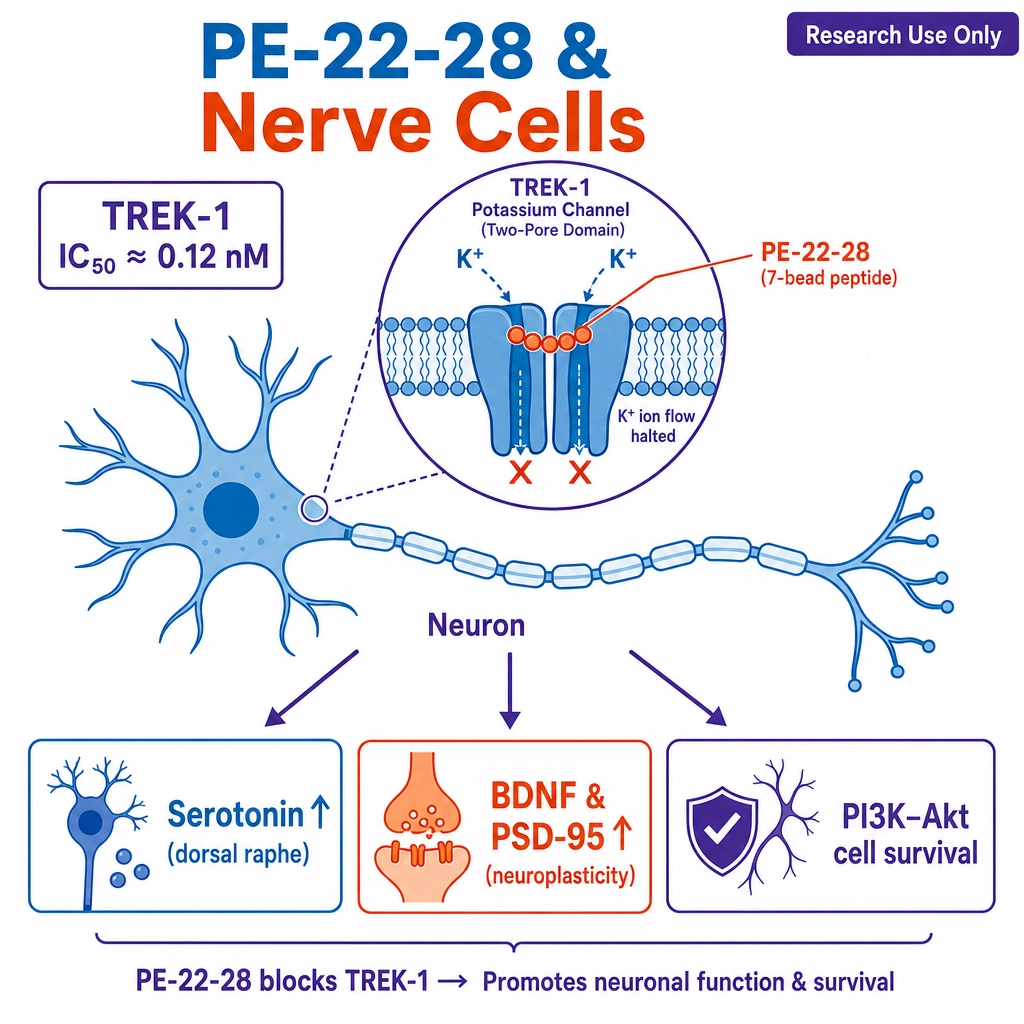
PE-22-28 is a seven–amino-acid spadin analog that research suggests blocks the TREK-1 potassium channel with very high affinity (reported in-vitro IC50 ≈ 0.12 nM, roughly 300× more potent than spadin). By reducing the TREK-1 leak current, it may disinhibit dorsal-raphe serotonergic neurons and engage BDNF/PSD-95–linked neuroplasticity. All data are from research models; PE-22-28 is for laboratory use only.
Origin: PE-22-28 is a truncated fragment of spadin (PE 12-28), a propeptide released during sortilin maturation.
Primary mechanism: high-affinity, selective blockade of the TREK-1 (K2P) potassium channel — reported in-vitro IC50 ≈ 0.12 nM vs. ~40–60 nM for spadin.
Downstream signals: potential serotonergic disinhibition in the dorsal raphe, plus BDNF, PSD-95, and synapsin increases consistent with synaptogenesis in research models.
Neuroprotection: spadin-class peptides engage PI3K/Akt and ERK1/2 survival pathways and shift dendritic spines toward mature "mushroom" morphology.
Status: research-use-only; no human data and no approved use.
What Is PE-22-28 and Where Does It Come From?
PE-22-28 is a synthetic peptide of seven amino acids derived from the degradation products of spadin (the PE 12-28 fragment), which itself originates from the post-translational maturation of the sortilin propeptide. In research settings it is studied primarily as a blocker of the TREK-1 two-pore-domain potassium channel, and in-vitro data suggest it may do so with considerably greater affinity than spadin.
The design rationale is straightforward: investigators mapped how spadin breaks down in blood and identified the shortest fragment that retained — and actually improved — TREK-1 activity. According to Djillani et al. (2017), this shortened analog displayed better channel inhibition, greater in-vivo stability, and stronger antidepressant-like activity in rodent behavioral models than the parent peptide. Because PE-22-28 is a clean, well-defined fragment, it has become a useful tool compound for probing TREK-1 biology in cultured nerve cells.
Beyond channel interaction, PE-22-28 is hypothesized to engage neuroplasticity pathways — promoting markers of neurogenesis and synaptogenesis — making it of interest to researchers who study how a single ion-channel target can ripple outward into structural changes at the synapse.
How Does PE-22-28 Block the TREK-1 Channel?
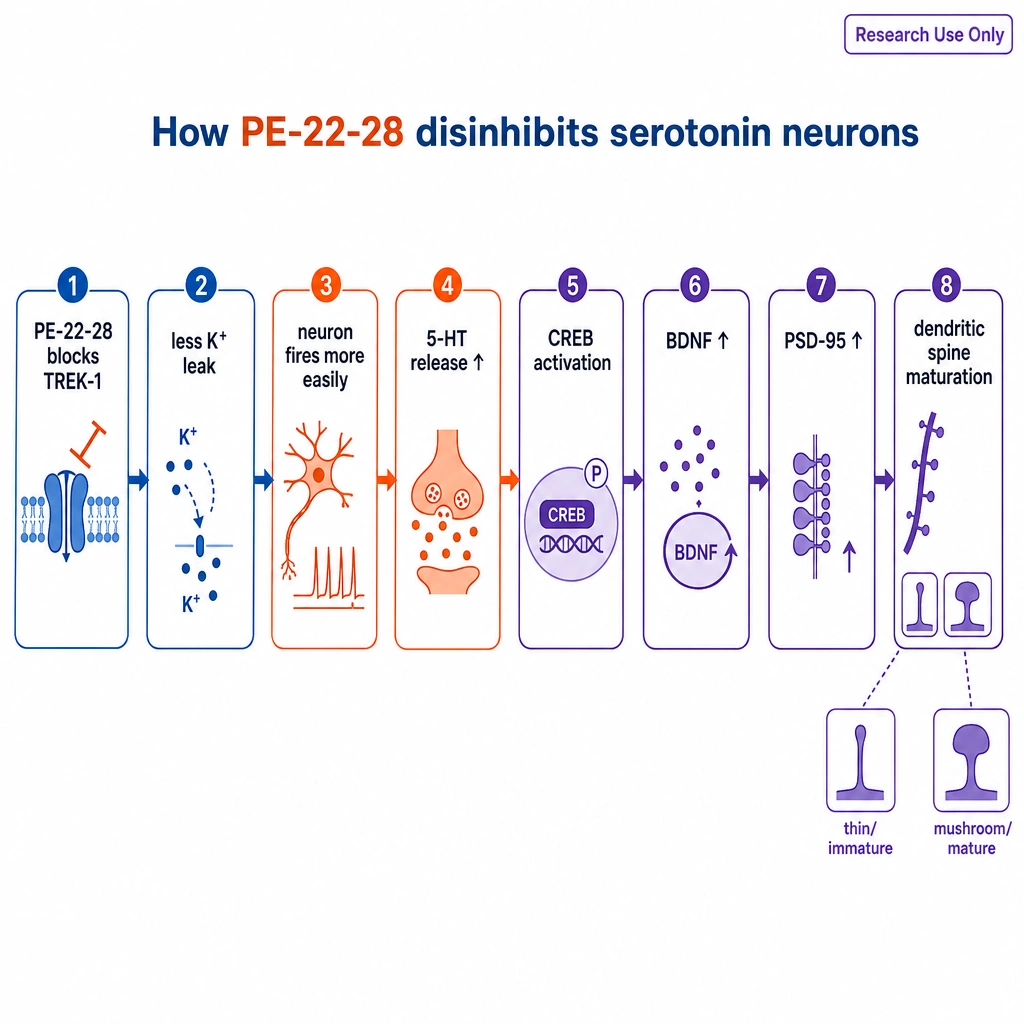
PE-22-28 is thought to act mainly by blocking TREK-1, a potassium channel that produces a background "leak" current which normally stabilizes the resting membrane potential and dampens neuronal firing. When PE-22-28 occupies the channel, that leak current falls and the affected neurons become easier to excite — the core mechanism proposed across the spadin literature.
Selectivity is a recurring theme. Within the spadin/PE-22-28 family, the blockade appears comparatively specific for TREK-1: reports indicate little to no effect on the closely related K2P channels TREK-2 and TRAAK, which is part of why these peptides are valued as selective TREK-1 tools. In the broader review by Djillani et al. (2019, Frontiers in Pharmacology), TREK-1 is positioned as a channel of interest across nervous-system biology precisely because of this kind of targeted pharmacology.
An important caveat noted in the literature is that TREK-1 is not confined to the brain. As highlighted in the work associated with Okada & Ortiz (2022), TREK-1 is also expressed in cardiac cells, raising a theoretical concern that channel blockade may not be entirely tissue-selective — a caution researchers keep in view when interpreting cell models.
How Might PE-22-28 Affect Serotonergic Neurons?
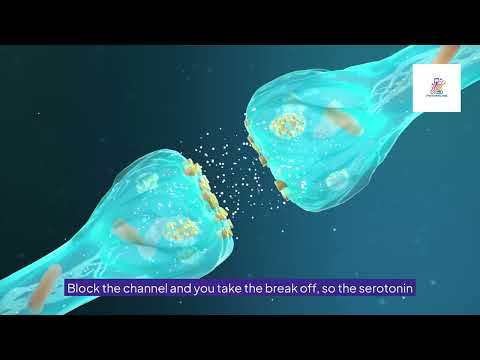
Research suggests PE-22-28 may facilitate serotonergic (5-HT) transmission by relieving TREK-1–mediated suppression of the neurons that produce serotonin. The clearest example is the dorsal raphe nucleus, the brain's principal source of serotonergic projections.
Work described by Okada & Ortiz (2022) and the surrounding spadin literature proposes that the peptide may reduce TREK-1 activity in dorsal-raphe neurons, cutting the potassium leak current that normally keeps them quiet. In the framing of that work, blocking the channel "activates the serotonergic neurons, resulting in the facilitation of serotonergic transmission." In other words, PE-22-28 does not add serotonin — it may remove a brake on the cells that make it.
A second, indirect route has also been proposed. According to Moha ou Maati et al. (2016), spadin-type TREK-1 blockade may first increase the activity of prefrontal pyramidal neurons, which then send excitatory glutamatergic input to the dorsal raphe and secondarily support serotonin-neuron firing. That study found TREK-1 to be functionally coupled to mGluR2/3 receptors — blocking mGluR2/3 with LY 341495 appeared to occlude spadin's action rather than add to it, pointing to a shared mechanism at the same channel. This dual model (direct disinhibition plus an indirect cortical loop) is one reason PE-22-28 is studied as a probe of circuit-level serotonergic control, not just single-cell electrophysiology.
Does PE-22-28 Influence Neuroplasticity and BDNF?
Yes — in research models, PE-22-28 and spadin are associated with markers of synaptic plasticity that extend beyond acute channel blockade. Later work by Djillani et al. (2019, Pharmacology & Therapeutics) suggests the peptide may promote neurogenesis after relatively short exposure and raise PSD-95 (Postsynaptic Density Protein 95), a scaffolding protein that helps synapses mature and stabilize.
Notably, the synaptogenesis signature reported for spadin includes not only PSD-95 but also synapsin, a presynaptic marker — a detail from Devader et al. (2015) that broadens the picture from a purely postsynaptic effect to coordinated pre- and postsynaptic remodeling. Rising PSD-95 is generally interpreted as an increase in functional synapses and better recruitment of AMPA receptors, which carry much of the fast signal between neurons.
The plasticity story connects back to BDNF (brain-derived neurotrophic factor). Because PE-22-28 derives from a peptide that binds sortilin with relatively high affinity, and because sortilin helps route BDNF into the correct secretory pathway, the peptide may indirectly alter BDNF handling. The proposed molecular link runs through TREK-1 blockade → increased serotonergic activity → activation of the transcription factor CREB → increased BDNF expression. The researchers reported "a rapid increase in both mRNA expression and protein level of brain-derived neurotrophic factor (BDNF) in the hippocampus."
What Neuroprotective Pathways Are Linked to PE-22-28?
Beyond channel blockade, spadin-class peptides may activate intracellular survival signaling. Research on spadin by Devader et al. (2015) suggests engagement of two pathways associated with neuronal survival and growth: PI3K/Akt and ERK1/2. In that work, the peptide appeared to protect cultured neurons from staurosporine-induced apoptosis via the PI3K/Akt pathway, while ERK signaling was linked to its synaptic-plasticity effects.
Structurally, spadin and PE-22-28 may promote the maturation of dendritic spines — shifting the balance toward larger, more stable mushroom-type spines without changing the total spine number. The Devader model proposes the same two sequential phases described above: an early BDNF/serotonin phase and a later spine-maturation and consolidation phase. The study also reported that spadin induces internalization of both TREK-1 and sortilin, which may sustain channel inactivation beyond simple occupancy of the pore.
PE-22-28 vs. Spadin: How Do They Compare?
PE-22-28 was engineered from spadin to improve potency, stability, and duration while preserving the same core TREK-1 mechanism. The table below summarizes the differences reported across the referenced studies.
| Property | PE-22-28 | Spadin (PE 12-28) |
|---|---|---|
| Length | 7 amino acids | 17 amino acids |
| Origin | Spadin blood-degradation fragment | Sortilin propeptide fragment |
| TREK-1 IC50 (in vitro) | ~0.12 nM | ~40–60 nM |
| Relative potency | ~300× higher | Reference |
| Action duration (animal models) | ~23 hours | ~7 hours |
| Channel selectivity | TREK-1 > TREK-2 / TRAAK | TREK-1 > TREK-2 / TRAAK |
| Reported plasticity markers | ↑ BDNF, PSD-95, synapsin | ↑ BDNF, PSD-95, synapsin |
| Status | Research use only | Research use only |
How is research-grade PE-22-28 characterized?
For cell and animal work, the meaningful quality questions are identity and purity, not marketing claims. Research-grade PE-22-28 is typically confirmed by reversed-phase HPLC for purity and by mass spectrometry for identity (observed vs. theoretical mass), handled under cold-chain conditions, and supplied strictly for laboratory use. At PrymaLab, research peptides are characterized with HPLC/MS identity and purity verification and independent third-party testing so that experimental results reflect the peptide, not a contaminant. No specific lot data are asserted in this general reference.
Frequently Asked Questions
What is PE-22-28?
PE-22-28 is a synthetic seven-amino-acid peptide derived from the blood-degradation products of spadin (PE 12-28), which originates from sortilin maturation. It is studied as a high-affinity, selective blocker of the TREK-1 potassium channel and is intended for laboratory research use only.
How is PE-22-28 different from spadin?
PE-22-28 is a shortened, optimized spadin analog. Djillani et al. (2017) reported an in-vitro TREK-1 IC50 near 0.12 nM (versus ~40–60 nM for spadin) and a duration of action near 23 hours (versus ~7 hours), i.e., markedly higher potency and stability while sharing the same mechanism.
What is the TREK-1 channel?
TREK-1 is a two-pore-domain (K2P) potassium channel that generates a background leak current, stabilizing membrane potential and reducing excitability. In dorsal-raphe serotonergic neurons, its activity suppresses firing; blocking it may disinhibit those neurons in research models.
Does PE-22-28 affect BDNF and PSD-95?
In research models, spadin and PE-22-28 are associated with rapid BDNF increases and elevated synaptic markers (PSD-95, synapsin), along with a shift toward mature mushroom-shaped dendritic spines — interpreted as synaptogenesis signatures, not demonstrated clinical effects.
Is PE-22-28 approved for human use?
No. PE-22-28 is a research-use-only peptide with no human data and no approved therapeutic use. It is studied only in vitro and in animal models.
What models are used to study PE-22-28?
Common systems include cultured dorsal-raphe serotonergic neurons, hippocampal preparations, TREK-1-expressing heterologous cells for electrophysiology, and rodent behavioral tests such as the forced swim test.
References
- Djillani A, Pietri M, Moreno S, Heurteaux C, Mazella J, Borsotto M. Shortened Spadin Analogs Display Better TREK-1 Inhibition, In Vivo Stability and Antidepressant Activity. Front Pharmacol. 2017;8:643. PMC5601071 · doi:10.3389/fphar.2017.00643
- Djillani A, Mazella J, Heurteaux C, Borsotto M. Role of TREK-1 in Health and Disease, Focus on the Central Nervous System. Front Pharmacol. 2019;10:379. doi:10.3389/fphar.2019.00379
- Djillani A, Pietri M, Mazella J, Heurteaux C, Borsotto M. Fighting against depression with TREK-1 blockers: Past and future. A focus on spadin. Pharmacol Ther. 2019;194:185–198. doi:10.1016/j.pharmthera.2018.10.003
- Moha ou Maati H, Bourcier-Lucas C, Veyssiere J, et al. The peptidic antidepressant spadin interacts with prefrontal 5-HT4 and mGluR2 receptors in the control of serotonergic function. Brain Struct Funct. 2016;221(1):21–37. doi:10.1007/s00429-014-0890-x
- Devader C, Khayachi A, Veyssière J, et al. In vitro and in vivo regulation of synaptogenesis by the novel antidepressant spadin. Br J Pharmacol. 2015;172(10):2604–2617. PMC4409910 · doi:10.1111/bph.13083
- Okada M, Ortiz E. Viral vector-mediated expressions of venom peptides as novel gene therapy for anxiety and depression. Med Hypotheses. 2022;166:110910. doi:10.1016/j.mehy.2022.110910
Final disclaimer: This article is an educational research reference. PE-22-28 is sold and studied for laboratory research use only and is not approved by any regulatory authority for human or veterinary use. Statements about PE-22-28 have not been evaluated by the FDA. Nothing here should be interpreted as medical advice or as a recommendation to administer any peptide to humans or animals.
Descriptions of mechanisms are hypotheses and observations from in-vitro and animal models; they may not generalize. Always verify the legal status of any research compound in your jurisdiction before purchase or use.